The Debt Reset Protocol
Why Your Debt Payoff Plan Breaks the First Month Something Goes Wrong
The Debt Reset Protocol is a credit card payoff plan that holds up when life gets in the way. Put every card in one place, compare debt snowball vs avalanche with your own numbers, and have a decision ready for the month that doesn't go to plan.
Get the Debt Reset Protocol ($27)Guide + 12-tab spreadsheet toolkit + bonus · Instant download · 30-day money-back guarantee

- 30-day money-back guarantee
- Instant download
- Guide + 12-tab spreadsheet toolkit + bonus
- Secure checkout by Gumroad
You check the balance at 1am.
Not because you forgot the number. You know it roughly, the way you know a bruise is there before you press on it. You check because everyone else is asleep, and it's the one hour of the day you can look at it without an audience.

You've tried to pay off the credit card debt. More than once.
A balance transfer felt like progress for a few months, until the promotional rate ran out and the balance was still sitting there. A budgeting app worked well for three weeks, right up until a car repair, a school fee or just an expensive month knocked the plan sideways.
You've tried willpower. You've taken snowball advice from one podcast and avalanche advice from another. Maybe you built a spreadsheet late one night with the best intentions, and now it lives untouched in a folder called "Budget FINAL."
None of that was stupid. And none of it failed because you're bad with money.
The missing piece
It failed because most payoff plans quietly assume something real life almost never gives you: an uninterrupted month.
No car trouble. No medical bill. No school expense. No month where everything costs more than you expected.
Then that month arrives. The plan doesn't fit anymore, so it gets dropped, and a few weeks later you're building a new one from zero and wondering what's wrong with you.
Nothing is wrong with you. The plan was missing a piece. Payoff calculators are easy to find, so the missing piece isn't the math. It's a decision made in advance for the month that breaks the plan.
How it works
That's what the Debt Reset Protocol is built around.
It works in three phases.
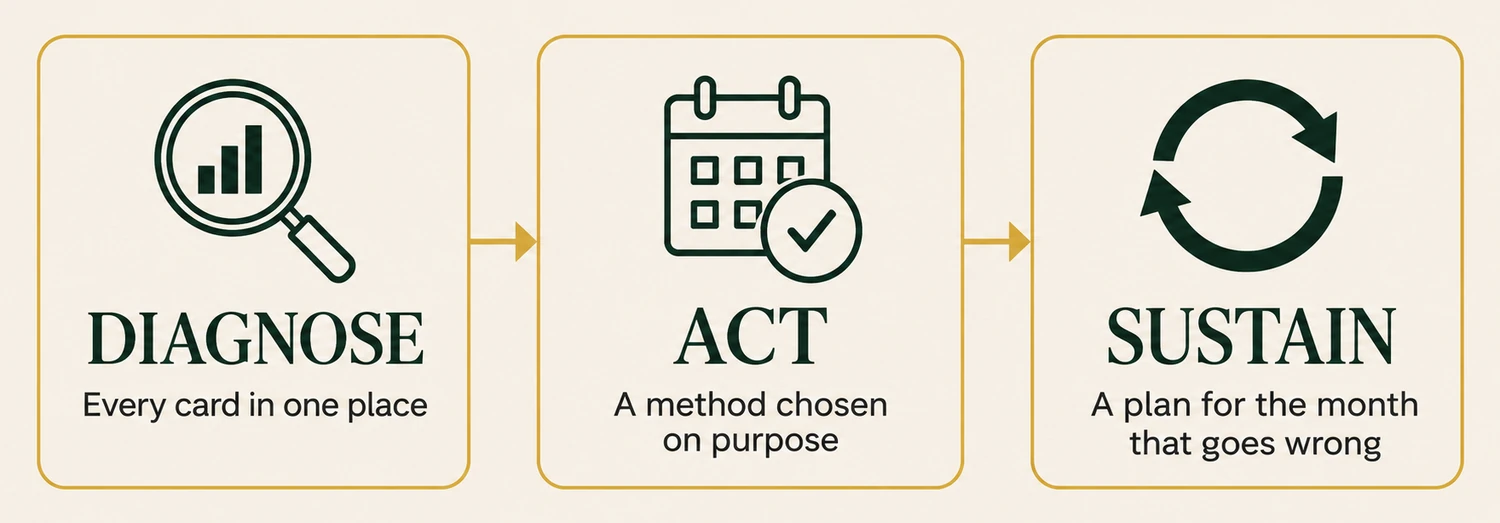
Diagnose. Every card, balance, rate, minimum and due date goes in one place, so "too much debt" turns into a specific starting point. You'll see how your balance, APR and minimum actually interact, and why the plans you've tried didn't hold.
Act. You compare snowball and avalanche with your own numbers, choose one on purpose and write down why. Then you turn that choice into a month-by-month payoff calendar and a budget with room in it for an irregular month.
Sustain. A five-minute weekly check-in keeps you connected to the plan without turning it into a second job. And for the month that goes wrong, there's the Interruption Protocol.
The Interruption Protocol
The Interruption Protocol is the heart of the system. When something happens, you don't improvise. You work through five questions, in order, before you touch a payment:
- What happened, exactly?
- How much does it actually cost?
- Is it essential, or can it wait?
- What still has to be paid no matter what?
- What's the smallest adjustment that keeps the plan alive?
Then you follow one sequence: Pause, Protect, Adjust, Communicate, Resume, Review.

Here's what that looks like in a real month. Say the car needs new brakes in the third week. Before, that bill would have ended the plan. Now you pause and run the five questions. Rent and every minimum payment stay covered. This month's extra payment gets smaller, and you mark the date it goes back to normal on your calendar. At your next check-in, you confirm nothing else slipped.
The plan bent. It didn't break. That's the rule the whole system runs on: adjusting the month is not abandoning the plan.
The system
What's inside
Everything comes as one system, so you can work through it step by step instead of piecing a plan together from ten different sources.
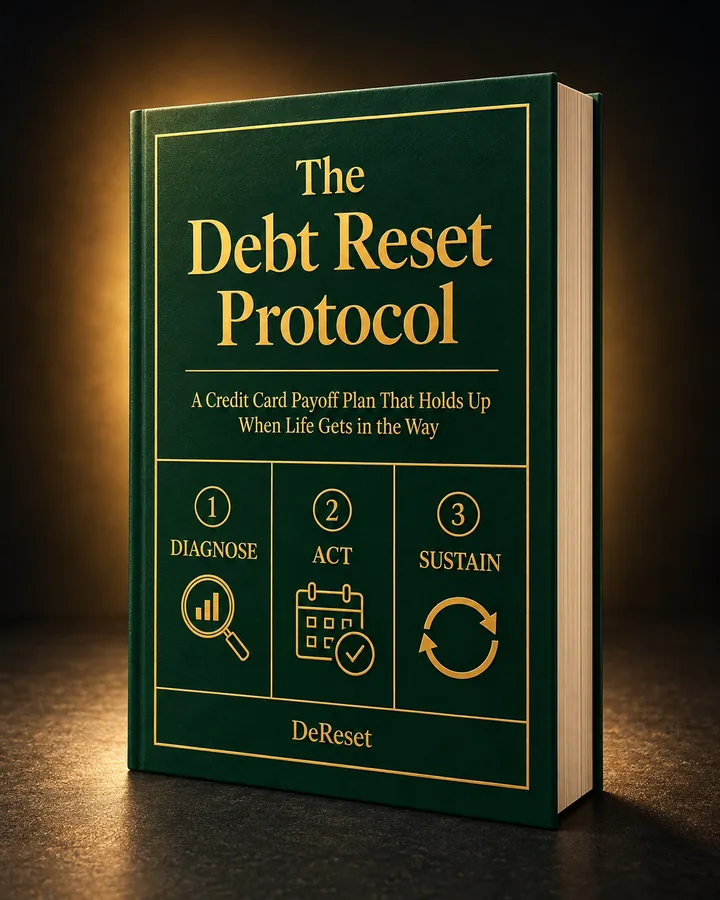
The Debt Reset Protocol guide
The full system, chapter by chapter: the Total Debt Reality Check, how your numbers really behave, choosing your payoff method, the payoff calendar, a budget that can absorb real life, the Interruption Protocol, the weekly check-in, balance transfers and other fresh-start temptations, and talking about the number. It ends with a 14-day path for putting it all into motion, and what to do once the last card hits zero.
The Debt Reset Toolkit
A debt payoff spreadsheet with 12 linked tabs. You enter your real numbers in the marked cells, and each tab either calculates your next decision or records what you did.
- Debt Reality Check: every card in one place, and your real starting point.
- Payoff Calculator: a payoff estimate for any single card.
- Method Comparison: a full snowball vs avalanche comparison using the same monthly payment.
- Payoff Calendar: your month-by-month payment plan.
- Monthly Budget: your real cash flow, irregular expenses included, and what's left to put toward the debt.
- Interruption Protocol: the decision sheet for the month that goes sideways, plus an If-Then Planner for deciding your responses in advance.
- Weekly Check-In: the five-minute ritual, with your balance trend.
- Balance Transfer: a side-by-side check of staying put vs transferring, so you can see whether an offer reduces the debt or just moves it.
- Payment Rollover: when a card hits zero, its payment moves to the next one.
- Partner Talk: a short, factual plan for talking about the number.
- Post-Debt Reset: a deliberate new job for the payment once the debt is gone.
- 14-Day Reset: your first two weeks as a checklist.


Bonus
50 Scripts for Talking to Your Partner About Debt
Fifty short scripts across ten conversations: starting the conversation, sharing the number, turning shame into a team problem, choosing a payoff method together, the monthly plan, the budget, talking through an interruption, a payment at risk, weekly check-ins, and milestones and setbacks. It also covers when to stop a conversation that's turning hostile or unsafe.
Getting started
Your first 14 days
You won't be left with a download and a good intention. The guide gives you a clear path for the first two weeks.
Day 1
Diagnose
Complete the Total Debt Reality Check. By the end of the day, the vague number is a clear, specific starting point.
Days 2 and 3
Act
Compare snowball and avalanche with your own numbers, choose on purpose, and map the payments onto your calendar.
Days 4 to 7
Build continuity
Build your budget, rehearse the Interruption Protocol on a made-up problem, and do your first weekly check-in.
Days 8 to 14
Keep going
Make your planned payments, check in again, update your numbers and confirm next month's plan.
The point isn't to be perfect for 14 days. It's to run the whole system once, so you know how to come back to it when a month gets messy.
Why I built it

I know what $18,000 of credit card debt feels like. I carried it, and I climbed out of it.
The number was hard enough. What it made me feel was worse. I'd get serious, make a plan, feel motivated for a while, and promise myself this was the month things changed.
Then real life would happen. An unexpected expense. A month that cost more than I'd planned. Something I hadn't accounted for. The plan I'd been so sure of didn't fit anymore, so I did what a lot of people do. I started over. Again. And again.
What finally became obvious was that I wasn't failing because I didn't know debt was bad, or because I needed someone to tell me to spend less. I was failing because my plans assumed life would cooperate.
So I looked harder at the advice people already use: budgeting apps, spreadsheets, snowball and avalanche, podcasts, books, forums. There was plenty of good advice, but the same piece kept going missing. What are you supposed to do when the plan gets interrupted? Most of it came down to "don't let that happen." That isn't a strategy.
I stopped looking for the perfect budget and started looking for a plan that could survive an imperfect life. First I put every card, balance, rate and minimum in one place, and for the first time I could see the problem instead of just feeling it. From there I could compare payoff methods with my own numbers and choose one on purpose.
The piece I still needed was a response for the month that goes wrong. That became the Interruption Protocol. The aim isn't perfection. It's continuity.
That's the Debt Reset Protocol. I didn't build it from a textbook. I built it because I needed it.
My numbers were mine, and yours will be different. That's the point: the plan you build here runs on yours.
Dana
Is it right for you?
Who it's for
This is for you if:
- you're carrying balances on one or more credit cards and paying at least the minimums;
- you've made a payoff plan before, and it broke the first time a month went wrong;
- you want a system you can follow when you're tired or stressed, not another lecture about spending less;
- you'd rather see the real numbers than keep carrying a rough, dreaded total around.
It isn't the right fit if:
- you're looking for someone to negotiate with your creditors or reduce what you owe for you. Nobody does that here: you pay down what you owe, on a plan you build;
- you're already in collections or facing legal action. Start by talking to your creditor and a nonprofit credit counselor; the guide explains how;
- you want help raising your credit score. That's a different problem, and this guide doesn't make credit-score claims.
Your order
Here's everything you get
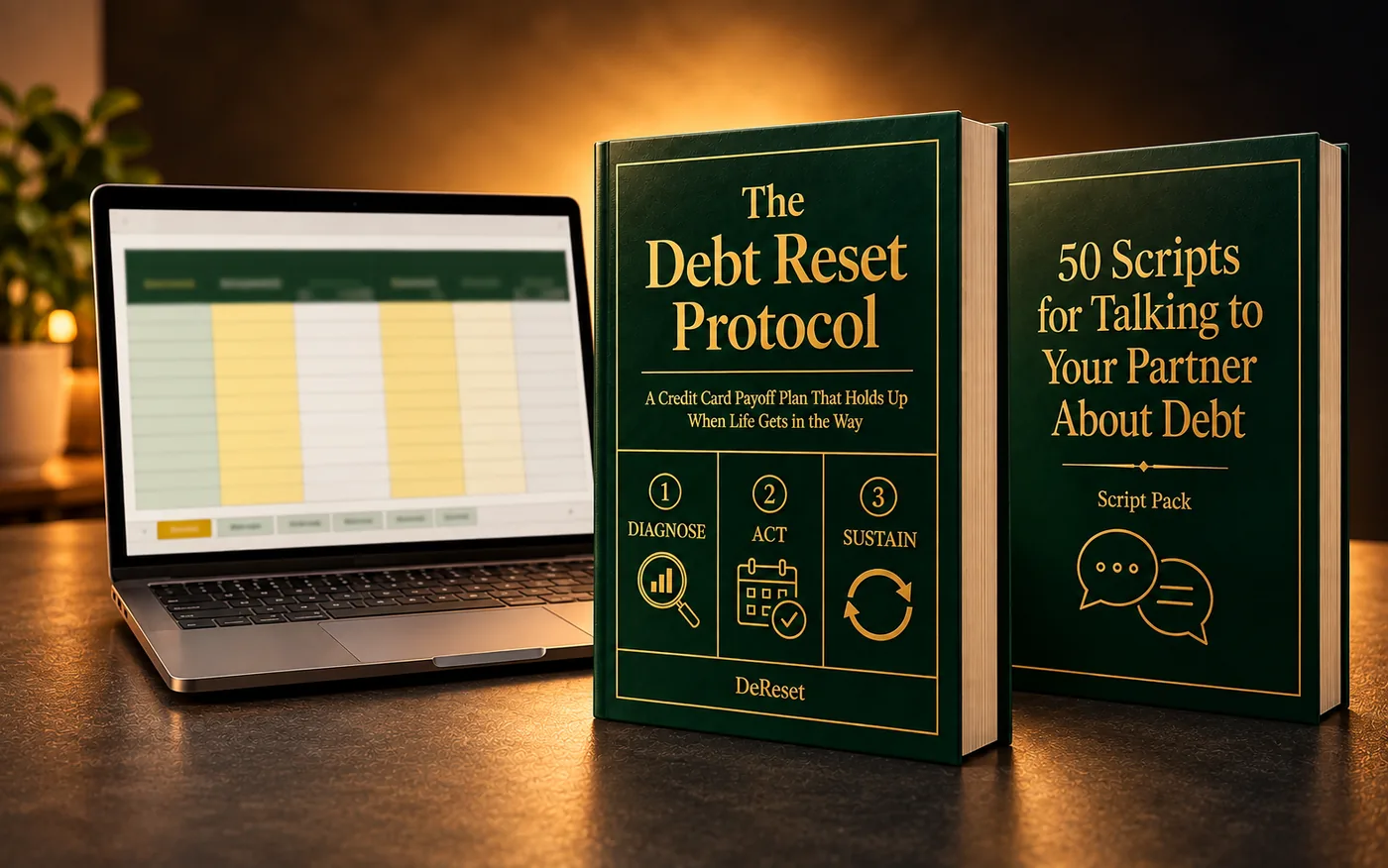
The Debt Reset Protocol guide + The Debt Reset Toolkit (12 linked tabs)
$27 value
Bonus: 50 Scripts for Talking to Your Partner About Debt
$17 value
| The Debt Reset Protocol guide + The Debt Reset Toolkit (12 linked tabs) | |
| Bonus: 50 Scripts for Talking to Your Partner About Debt | |
| Total value | |
| Everything today | $27 |
One payment, instant download.
Get the Debt Reset Protocol ($27)Guide + 12-tab spreadsheet toolkit + bonus · Instant download · 30-day money-back guarantee

30-Day Money-Back Guarantee
Try the Debt Reset Protocol for 30 days. If it doesn't help you build a payoff plan you can keep following when a month goes wrong, email me at [email protected] within 30 days and I'll refund every cent. No hoops.
Questions
Before you decide
Will anyone contact my creditors or negotiate my debt for me?
No. The Debt Reset Protocol is a plan you build and run yourself, with your own numbers. Nothing is negotiated, reduced or forgiven on your behalf. What you get is a clear way to pay down what you owe and keep going when a month goes wrong.
I already know about snowball and avalanche. What's different here?
The comparison is in here, and it runs on your own numbers. But the difference is what happens after you choose. Most plans stop at the method. This one includes a decision process for the month that breaks the plan, so an interruption becomes an adjustment instead of the end.
Do I need to be good with spreadsheets?
No. The toolkit is an .xlsx file you open in a spreadsheet app such as Excel. You type your numbers into the marked cells and work through the tabs in order. The tabs are linked, so the calculations carry through.
What if I only have one card?
It still works. The Payoff Calculator tab is built for a single balance, and everything else in the system applies the same way.
What if I'm already behind on a payment?
The guide covers this. The short version: contact your creditor before the due date, not after, and ask what options they offer. If the numbers no longer fit your income, nonprofit credit counseling can help. Be wary of any company that tells you to stop paying your creditors.
Do I have to involve my partner?
No. If you have a partner and want to talk about the number, the guide's last chapter and the 50 Scripts bonus help you do it without it turning into a confession or a fight. If you'd rather work through it alone, the system works the same way.
Is this financial advice?
No. It's educational. The payoff dates and interest totals it produces are estimates, calculated from the numbers you enter. The regulatory references are U.S.-specific. For personal financial, legal or tax advice, talk to a qualified professional.
How do I get it?
Right after checkout, you'll get a receipt email with your download links. Your files also stay in your Gumroad library, so you can download them again anytime.
You don't need another perfect month. You need a plan that knows imperfect months happen.
If you've been carrying the number around in your head, you already know how tiring it is not to know where you stand. You can keep rebuilding the same spreadsheet from scratch. Or you can spend one evening getting the full picture, choosing a method on purpose and putting the first real version of your plan on paper.
Start with the Total Debt Reality Check. Twenty minutes and your latest statements, and you'll know exactly where you stand.
Get the Debt Reset Protocol ($27)Guide + 12-tab spreadsheet toolkit + bonus · Instant download · 30-day money-back guarantee